




EXCLUSIVE: TEDDINGTON INVENTION IS SHORTLISTED FOR ASTRONAUTS ON THE NEXT SPACE STATION
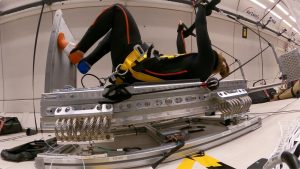
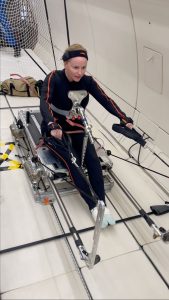
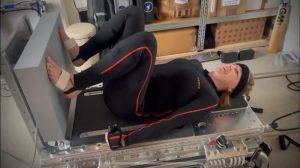
A unique piece of exercise equipment invented and built in Teddington has been shortlisted to be considered to join the Lunar Gateway programme which will provide a new manned space station to orbit the Moon, we can exclusively reveal today.
The HIFIm (High Frequency Impulse for Microgravity) counter-measure device enables astronauts to exercise in space by ‘jumping’ for between four and six minutes which prevents bone density loss and enables astronauts to stay fit in space.
It has been shortlisted by ESA (European Space Agency) and NASA as one of three devices – the two others are from Germany and Denmark – but the UK’s equipment has two distinct advantages of being powerless and lighter in weight which is a significant factor for the space station.
Former aircraft engineer John Kennett, who runs the pilates studio in the Royal British Legion building in Teddington’s High Street where the space equipment has been designed and built says: ” HIFIm represents the next generation of hardware, delivering cutting-edge equipment, training, monitoring, and programming to keep space explorers at peak performance.
“Our work is powered by collaborations with major space agencies, including the UK Space Agency, ESA, CSA and others, backed by significant funding that solidifies the UK’s leadership in space exercise countermeasures.
“But our mission doesn’t stop at the stars. On Earth, we’re harnessing HIFIm to transform healthcare, developing innovative solutions for osteoporosis, rehabilitation, and chronic conditions, enhancing bone, muscle, and cardiovascular health for patients.
“Beyond that, we’re crafting military-focused exercise systems tailored for confined spaces, injury prevention, and rapid recovery, ensuring resilience in the toughest environments.
“At PML, we’re driven by a dual purpose: pushing the boundaries of human potential in space while improving lives here on Earth. From microgravity to everyday mobility, we’re committed to making a lasting impact, one breakthrough at a time.
PML has formed a formidable consortium with Kayser Space and KBR to respond to the European Space Agency’s Invitation to Tender. This effort is described by Kennett himself as a “monumental undertaking,” highlighting the sheer volume of documentation involved in the process.
The impressive team behind the project includes Professor Dan Cleather, PML’s chief scientist, on secondment from St Mary’s University, Twickenham.
Laura Weyrowitz, an expert in astronaut training from KBR, adds her expertise to ensure the equipment’s functionality aligns with astronaut needs.
The design and potential manufacturing of the HIFIm for the Gateway are under the watchful eyes of Dominic Touhy, an Oscar-winning special effects guru known for his work on “Star Wars,” “Mission Impossible,” and “1917,” alongside lead SFX engineer Vince Abbott.
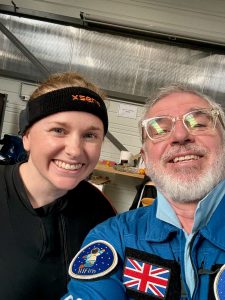
Laura Weyrowitz, along with ESA’s Director of Medical Projects and Technologies Work Package Lead for KBR within the ESA Space Medicine Team, Dave Green, flew in from the European Astronaut Centre, to visit the Teddington project reinforcing the international interest and support for the invention.
Dave Green from the ESA in Cologne, Germany, told Teddington Town: “HIFIm is a simple but elegant solution to one of the key questions in human spaceflight – namely how do you remain fit for a return to earth after being in microgravity.
“On the ISS 3 large and bulky devices are used – for up to 2 hours a day. HIFIm may not only be more effective, but also require a fraction of the time.
“However, the simple elegance comes from the use of springs and a counter mass system to solve one of the key challenges of spaceflight – how do you prevent the vibrations induced by exercise shaking, and potentially fracturing the space craft or station.
“By counteracting the accelerations of the body HIFIm is able to be operated without the complex and bulky vibration isolation systems required by the current generation of ISS exercise devices.
“Thus, HIFIm represents an opportunity to revolutionalise exercise in space – and with the lessons learnt – change how we approach exercise back on earth.”
John adds: HIFIm stands out due to its innovative approach to exercise in microgravity. Unlike traditional equipment, it also enables jumping to maintain muscle and bone mass, vital for maintaining astronaut health during prolonged space missions.
“This technology could redefine fitness in space is approached, potentially impacting future space travel and even health programmes such as tackling osteoporosis here on Earth.”