


HOW TEDDINGTON SCHOOL HAS BECOME A TRAILBLAZER IN EMBRACING ARTIFICIAL INTELLIGENCE (AI)
Teddington School featured in a significant article in The Times magazine on Saturday exploring how the school, its teachers and pupils had learned how to use AI (artificial intelligence) without totally depending on it but using it as a tool or aid to support their schoolwork. The article is reprinted here with the kind permission of Teddington School. KATIE STRICK speaks to staff and students Deputy head Dale Spick with pupils Jude Ford, 16, and Daisy Smith, 17, at Teddington School in southwest London
Welcome to Britain’s first AI classroom
How can the next generation be taught to use artificial intelligence to futureprooof their careers? A school in southwest London is pioneering a radical approach to new technology.
It’s week four of the new academic year at Teddington School in southwest London and nine sixth formers are debating the age from which pupils should be allowed to use artificial intelligence to help with schoolwork.
“I think 16,” says Yasmin Bartholomew, 16. When revising, she’ll analyse a text herself, then feed her ideas into AI to see what she has missed; she also uploads practice essays alongside the exam-board mark scheme and asks it to grade them. It saves her hours, and means bothering her teachers less — but she thinks a certain level of maturity is needed to use it responsibly.
Yasmin Bartholomew, 16: “AI helps me now, but I don’t feel like I’m actually learning.”
Her classmate Jude Ford, 16, shakes his head. He learnt his lessons the hard way. In the early days of ChatGPT, he was caught out in history after submitting work containing words he couldn’t explain. These days he checks AI-generated material carefully before using it and tends to use it as a research tool — finding studies and sources for his EPQ (Extended Project Qualification), for example, rather than asking it to write the work itself.
“I think you should be allowed it from 14,” he says, to a chorus of agreement from his fellow year 12s. “By the time it comes to proper exams like GCSEs, you should be able to use it.”
Only Joseph Jordan, 16, disagrees. Why impose an age restriction at all? Children can use the internet at any age, he points out, so attempting to keep them away from AI is futile. Besides, if you are going to discover the hard way that using ChatGPT to do your work leaves you incapable of doing it yourself, perhaps it is better to learn that lesson at 12 than 17.
That distinction — between using AI and letting it do your thinking for you — comes up again and again during my day at Teddington. In deputy headteacher Dale Spick’s economics lesson, pupils first mark one another’s exam answers using the examiner’s mark scheme, then ask AI to do the same.
Their task is not to accept the machine’s verdict, but to interrogate why its marks differ from their own. It’s a revealing exercise, and a neat illustration of the central question hanging over my day with Britain’s ChatGPT generation: how do you teach children to use a technology that can increasingly do their work for them, without allowing it to replace the thinking they came to school to learn?
For teenagers growing up in 2026, that is no longer a hypothetical question. Technically, Teddington’s 1,470 pupils can’t use ChatGPT at school: large language models (LLMs) are blocked on their school issued iPads and their phones are locked away during the school day.
Sixth-formers tell me the restrictions are difficult to circumvent. But the boundary ends at the school gates — at home, ChatGPT is only a phone or laptop away.
Teddington knows it cannot control what happens beyond its premises. The challenge, therefore, is not stopping teenagers from using AI but teaching them to use it. The pupils I speak to are already keenly aware of the trade-offs: AI makes schoolwork faster, but can make them lazier; it can explain what they don’t understand, but confidently get the answer wrong; it can help them learn, but also make it dangerously easy not to.
Dale Spick, deputy head: “I think of the technology as more of a tutor than a teacher.”
It’s a balancing act schools across Britain are urgently trying to navigate. A report published last month by the educationalist Sir Anthony Seldon and venture capitalist Tim Bunting warns that Britain’s education system is still teaching for an “AI-less world that no longer exists”, leaving schools scrambling to catch up with pupils who have already embraced the technology.
Drawing on National Education Union data, the report found that 49 per cent of English schools have no formal AI policy and 66 per cent offer no guidance on how pupils should use it. In separate Public First polling of 4,021 young people aged 11 to 24, only 30 per cent said their school had clear rules on AI.
More strikingly, those young people were more likely to turn to AI than another human to check a fact — 47 per cent v 21 per cent — or explain something they did not understand — 38 per cent v 24 per cent.
Which raises a rather existential question: if an AI assistant can provide an answer faster than a human, what exactly is school for?
Teddington is an interesting place to look for an answer. There are screens everywhere I look: iPads propped up on tables in the sixth-form centre, glowing from desks in the library, carried through corridors and out into the playground. Yet this is also a school where phones must be surrendered and AI chatbots are blocked on school devices.
The apparent contradiction is a deliberate one. Earlier this month, the southwest London academy became the first secondary school in the UK to be awarded AI in Education (AiEd) Explorer Status, an accreditation recognising schools developing a safe and structured approach to artificial intelligence. It was also shortlisted for Best Use of Technology at this year’s Tes Schools Awards, and has introduced new AI guidance for pupils, teachers and parents with the aim of making responsible AI use a priority.
The school has even hosted principals and education leaders from Australia and Estonia, Ontario’s education minister and representatives from the Dutch Primary and Secondary Education Councils, keen to see its approach to AI.
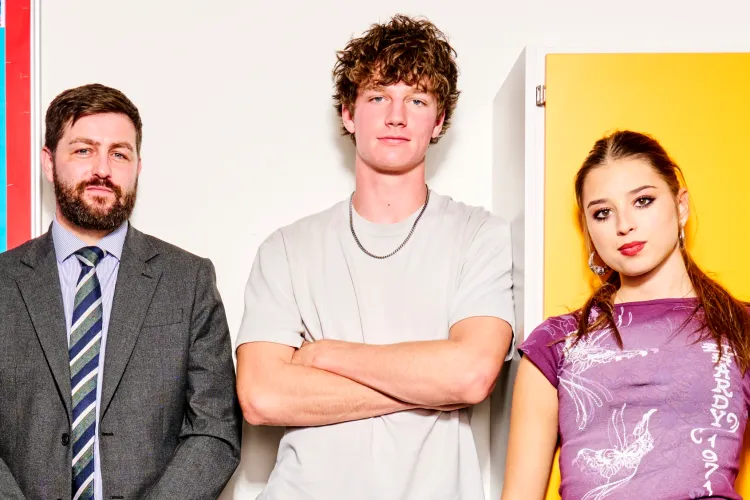
The intention isn’t to keep AI out, Spick explains, but to teach pupils when and how to use it. A phrase I hear repeatedly throughout my visit is “the human in the loop”. “The human in the loop is always the most important,” Spick says.
This philosophy is clearest when it comes to homework. Rather than pretending pupils aren’t using AI once they leave the school gates, Teddington now asks them to explain how they’ve used it.
Alongside an assignment comes a sheet of questions such as “How did using AI help you understand the topic better — or make it harder to understand?” and “How did you make sure your use of AI followed the rules?”
Could AI make pupils better critical thinkers?
The point isn’t to catch pupils cheating. Spick wants them to think about how they are thinking. “We have to teach them not to accept an AI response at face value but to question it, test it against their own knowledge and other evidence, and identify where it may be wrong or incomplete,” he says.
In fact, Spick believes AI could make pupils better critical thinkers. The irony right now, however, is that they are learning to evaluate what AI tells them, “but they’re not doing that to the teacher”. He wants that same scepticism applied to both: for pupils to interrogate information regardless of whether it comes from ChatGPT or the person standing at the front of the classroom.
The pupils I speak to appear to have absorbed at least half of that message. Technology is already woven into their lives, from the algorithms deciding what appears on their TikTok feeds and Netflix recommendations to Snapchat’s AI chatbot.
Yet when it comes to using AI deliberately for schoolwork, they are surprisingly sceptical. The girls around the table worry about becoming lazy or “dumbed down”.
Several point out that anyone who gets ChatGPT to write their essays all year will eventually find themselves sitting in an exam hall without it — their loss. Yasmin admits that at 12 or 13 she used AI “a bit more than I should have”, before realising, “This helps me now, but I don’t feel like I’m actuallylearning.”
Jude remembers a chatbot confidently getting quadratic equations wrong.
Yeva Gordiy, 16: the impact of AI has made her rethink her career choices. And when I ask who they would believe if AI and a teacher gave conflicting answers, the answer is
strikingly universal: the teacher. Well, “some teachers”, at least. AI, Jude says, “just kind of pours knowledge on you”.
His human teachers know the syllabus, the exam technique and what pupils actually need to learn. In Stem subjects particularly, the pupils point out, there is a difference between being
given the right answer and understanding how to reach it.
Spick draws a similar distinction. “I think of it more as a tutor than a teacher,” he says of AI. “I don’t think it’s replaced students asking staff for help at the end of a lesson.”
It is the same “human in the loop” principle behind his economics exercise that afternoon. Pupils useAI’s judgment, but don’t surrender their own to it. “Digitalisation should enhance teaching,” Spick says. “It should never replace it.”
The same principle applies to the adults I meet at Teddington. Simon Landrum, a science teacher, uses AI to turn curriculum material into Codenames-style games, but worries about inexperienced teachers relying on it before they know their subject well enough to spot its mistakes. Odin Turner, a maths teacher in his second year of teaching, deliberately models his use of AI in front of pupils — including letting them watch when it fails. “If I’m at the front struggling with AI, it’s good for them to see that,” he says.
All of which comes pretty close to where Seldon and Bunting believe schools must ultimately end up. As AI becomes more powerful, education must become “more human”, they argue. Machines should be used to swallow some of teachers’ grunt work while preserving their time for the conversation, challenge and critical thinking that machines cannot provide.
Yet the humans adapting to AI aren’t only inside the classroom. Teddington has started issuing guidance to parents too. “Go back a few years and you would always hear from parents: ‘I don’t know how to do this homework,’” Spick says. “Now they can use AI to support them.”
Jake Mayne: “In 30 years, AI will have done a lot more good than bad.”
Listening to year 12s, however, I begin to wonder whether some parents need less encouragement. If there is one thing that surprises me more than the teenagers’ scepticism, it is how readily some of their parents seem to have embraced AI. One father uses it to scan his work meetings; another uses it to build presentations and apparently asks it “everything”. A third is said to invoke it during family disagreements.
When one girl wonders aloud whether there might be a gender divide — “I don’t know if it’s a gender thing, but they love the Claude” — a ripple of laughter goes around the table. The “AI dads” seem to have become a recognisable species.
Mothers are hardly immune either. One regularly warns her daughter against becoming over-reliant on AI, despite having a Claude subscription herself; another uses it to compose personal text messages, much to the teenagers’ horror.
For all the parental enthusiasm, their children seem rather less attached. When I ask Yasmin what she would miss if ChatGPT disappeared tomorrow, her answer is surprisingly practical: mostly the speed with which it finds resources. Its disappearance would be “annoying”, she thinks, but “not the end of the world.”
The picture of AI use at home raises a more serious question too: who is best placed to navigate this new machine-reliant world? Teddington is one school in one particularly affluent corner of southwest London.
It sits within Richmond upon Thames, one of the capital’s wealthiest boroughs, and five of its seven year groups have access to one-to-one devices. Spick says approaches to AI already vary substantiallybetween schools, even across the Bourne Education Trust’s 31 schools in London, Hampshire and Surrey.
Jude Ford, 16: “By the time it comes to GCSEs, you should be able to use AI.”
That matters. After all, the ability to say “I’d rather ask my teacher” depends on having a teacher you can ask, with enough time to answer.
Yet AI could also help close some of these gaps. Jo Twigg’s daughter Ella, a year 12 student at Teddington, has verbal processing difficulties and struggled with dense textbooks. After failing several of her February mocks, she and her mother began using Copilot to strip revision material back to key concepts. Ten weeks later, she passed every GCSE. “It literally unlocked the information for her,” Twigg says. “You can’t expect teachers to have 20 different individual study guides.”
For the pupils themselves, however, there is one question on which their scepticism becomes rather more personal: their future careers. Jake Mayne, 16, thinks that in 30 years AI will have done “a lot more good for the world than bad”.
Several girls immediately shake their heads. Even he concedes that the job market they graduate into could be considerably smaller.
Around the table, almost every career aspiration seems to come with an AI calculation attached. Max Watson, 16, wants to become a dentist. If anything, AI has made him more certain: dentistry feels relatively “foolproof” from automation, with too much human interaction.
He is less sentimental about the “soul-crushing office jobs”. His father, who works in advertising, is retiring next year and fears he wouldn’t have a job in five years.
For Yeva Gordiy, 16, the calculation has gone the other way. She had imagined a future in pharmacology or lab work, but is now considering diplomacy instead.
Even the creative types are making contingency plans. Yasmin hopes to work in film or media; Daisy Smith, 17, wants to write. Both know that the technology they use can already generate the sort of material they hope to be paid to produce.
This is, perhaps, the strangest thing about being 16 in 2026. While previous generations of sixth-formers had to decide what they wanted to do when they grew up, this lot have an additional question to answer: by the time they get there, will that job even exist — or will their 24-hour tutor have taken it?